
Knowledge base · Apparel mailers
Poly mailers for apparel: sizing, closures and returns.
Specify the packed garment, usable bag dimensions, film construction, seams, labels and return workflow as one mailing system.
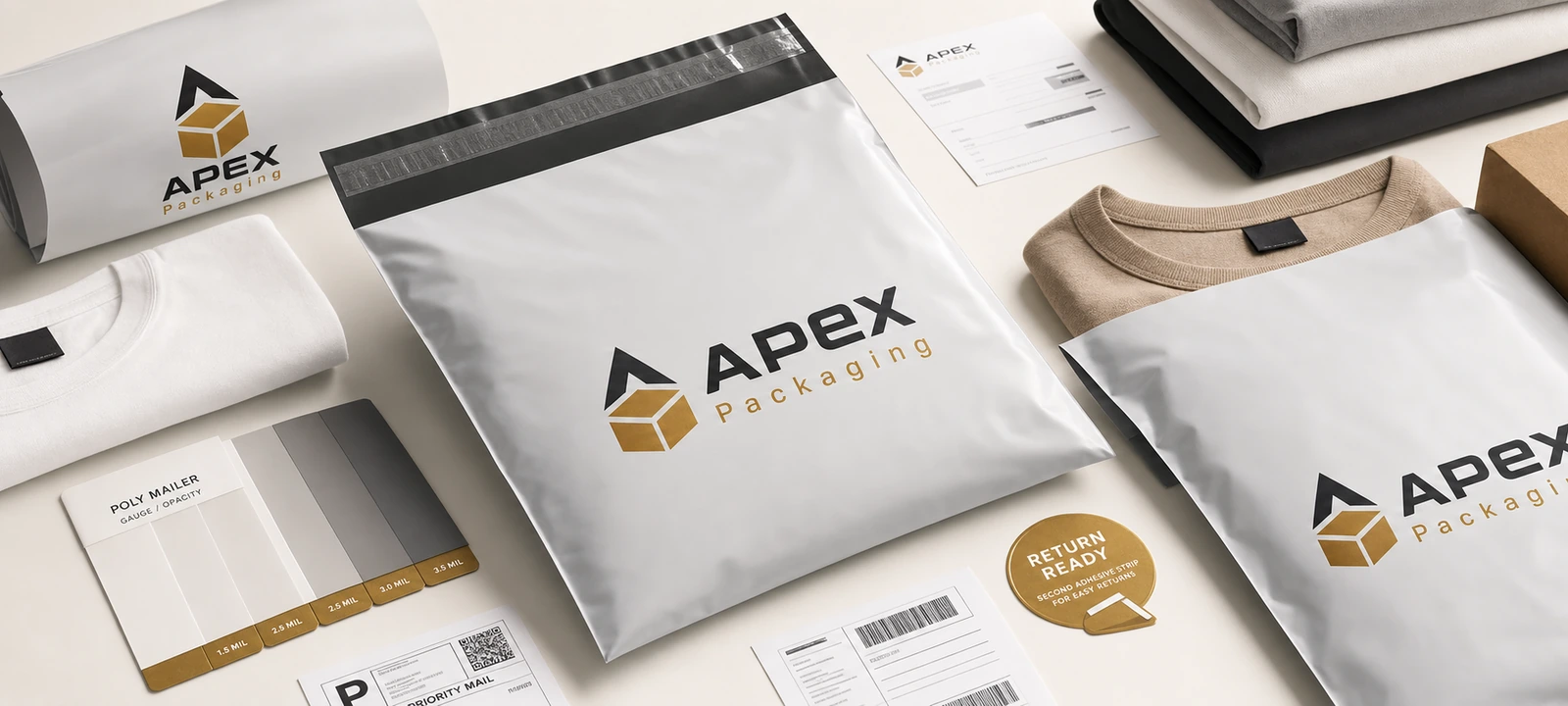
Poly mailers are most useful when flexible, non-fragile soft goods need a lightweight parcel format. The buyer still needs to define the folded product size, film and seam specification, closure, opacity, print, shipping label and any return workflow. A nominal bag size or film thickness alone is not a complete specification.
Use this guide to prepare the buying brief. For an Apex purchasing enquiry, review custom poly bags and mailers and send packed dimensions, product weights, quantities, artwork status and delivery destinations.
Measure the packed garment
Fold and prepare the item exactly as it will enter the mailer, including any inner bag, tissue, hangtag, literature or bundled accessory. Record length, width and maximum thickness without relying on excessive compression. Check the largest and smallest garment sizes and fabrics that behave differently when folded.
Ask the supplier to confirm whether quoted dimensions are internal, external or flat dimensions and how side seams, bottom seals, flap depth and closure position reduce usable space. A bag that fits the smallest SKU closely may be slow to pack or distort the adhesive seal on a larger SKU.
Do not specify performance by thickness alone
Record the proposed resin and film construction, nominal thickness and tolerance, opacity, surface treatment, seam design and closure. If puncture, tear, tensile or seal behaviour matters, define the relevant test method, sample preparation and acceptance criteria with the supplier.
ASTM D882 covers tensile properties of thin plastic sheeting and warns that results depend on variables including thickness, preparation and test conditions. It does not turn one tensile value or gauge into a complete parcel-suitability decision.
Choose closures around outbound and return handling
| Closure decision | Question to answer | Review point |
|---|---|---|
| Outbound seal | How is the flap aligned and sealed during packing? | Seal area stays clean, flat and within the usable length |
| Opening feature | How does the customer open the pack without damaging the contents? | Tear location and sharp-tool risk |
| Return closure | Can the original mailer be securely closed again? | Second strip location, instructions and condition after opening |
| Tamper indication | What visible evidence is required by the business process? | Agreed construction and wording, not an assumed claim |
Plan print, opacity and shipping labels together
Define which contents must be concealed, which panels carry artwork and where variable carrier labels will be applied. Test ink, coating and label adhesion on the proposed film surface. Keep high-value artwork and required information away from seams, flap folds and expected label zones.
Canada Post’s packaging guidance says labels should be flat, wrinkle-free and not wrapped over an edge or crease. Check the actual packed mailer because a label zone that is flat on an empty bag can curve over the folded garment.
Check whether the parcel route suits a flexible mailer
Canada Post describes polybags as an option for smaller, flat, non-fragile items while noting that bags can tear. Hardware, rigid accessories, sharp edges, crush-sensitive items or excessive empty space can make a different format or added protection more appropriate. Review the complete contents and route rather than assuming all apparel can use the same mailer.
Hypothetical size trial: three shirt sizes share one mailer. The smallest packs cleanly, but the largest pulls the flap into the shipping-label zone. The team can compare another fold, a second mailer size or a revised label area before approving one universal specification.
Apparel mailer RFQ checklist
- Folded dimensions, packed weight and variation by garment size or bundle.
- Inner bags, tissue, hangtags, literature and rigid accessories.
- Proposed film construction, thickness tolerance and performance criteria.
- Seam layout, flap depth, outbound seal and opening method.
- Return-closure and return-label workflow, if required.
- Opacity, artwork files, print references and carrier-label zone.
- Quantity by size or artwork version and delivery destinations.
- Parcel route and agreed sample or validation plan.
Frequently asked questions
How should apparel be measured for a poly mailer?
Measure it after folding, bagging and compressing it as it will be packed. Check representative size and fabric variation, then confirm usable dimensions with the supplier.
Does a thicker film automatically make a better mailer?
No. Film construction, sealing, seams, puncture and tear behaviour, contents and route also influence performance.
When is a return strip useful?
A second closure can support a return program when the opened mailer remains suitable for reuse. Define the opening method, return closure, instructions and label process together.
Primary references
Related
Quote the mailer around the packed garment.
Send folded dimensions, product weights, closure and return needs, artwork, quantities and destinations for a poly-mailer quotation.