
Knowledge base · Ecommerce shipping
Heavy ecommerce shipping boxes: a buyer’s guide.
Start with packed weight, but specify the complete product-and-package system around movement, handling, stacking, closure and the real distribution route.
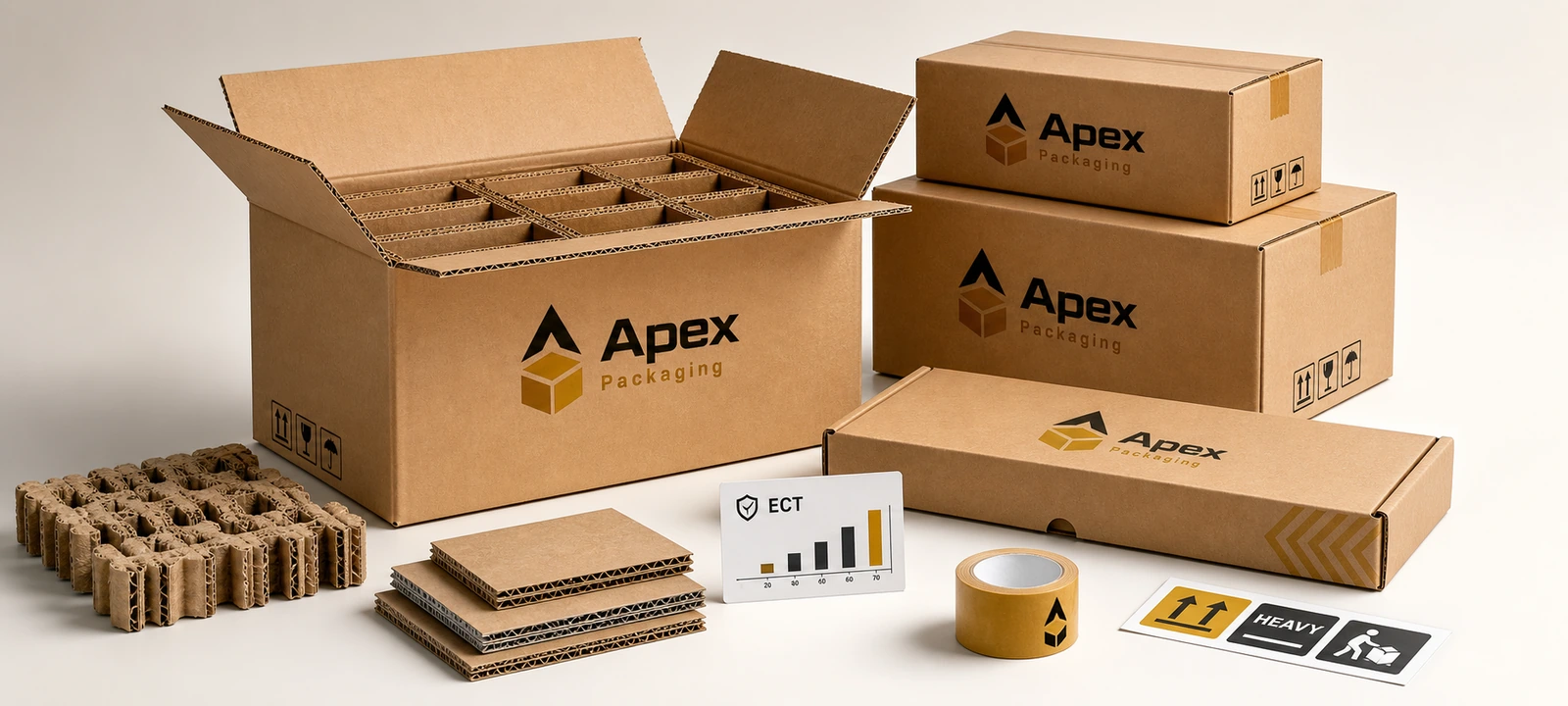
A heavy ecommerce order needs more than a heavier-sounding board grade. Packed weight matters, but it does not describe the box dimensions, how the product supports the panels, whether contents can move, how the box is closed, how high it is stacked or what parcel handling it will encounter. Specify and validate the packed system rather than selecting corrugated board from one number.
For a purchasing enquiry, review Apex’s corrugated shipping boxes and send the product, packed weight and dimensions, quantity, artwork, route and destination. The process below helps buyers prepare those inputs.
Document the packed load, not only the product weight
Weigh the shipment after all inner packs, inserts, void fill, literature and sealing materials are added. Record external dimensions and the centre of gravity. Identify rigid edges, protrusions, delicate surfaces and any liquid or loose component that creates a different failure mode.
Also note whether the product supports the box panels or leaves broad unsupported areas. Two shipments at the same weight can load the corrugated container very differently. Long narrow boxes, shallow wide boxes and concentrated metal parts should not be treated as equivalent.
Control movement and concentrated loads
Internal protection should keep the product away from vulnerable panels and prevent repeated impacts inside the box. The solution may involve closer sizing, dividers, pads, blocking or cushioning selected for the product and route. Verify that protective components stay in position after vibration and impacts rather than judging the pack only on the bench.
Hypothetical example: a 14 kg machine part sits in a much larger carton with loose fill. A second concept uses a smaller carton and supports that locate the part away from the sidewalls. The second concept is not automatically adequate, but it gives the test team a defined load path and movement-control system to evaluate. The decision should come from the complete specification and validation results.
Read board specifications as a set of properties
Edge crush test (ECT) measures an edgewise compression property of corrugated board. It is useful specification data, but it does not by itself state the compression strength or parcel performance of a finished box. ASTM D5639 describes multiple approaches to selecting corrugated materials and construction from performance requirements, including the interaction of compression needs, material characteristics and environmental hazards.
Ask the supplier to identify the complete board combination and construction, not only an ECT value or flute letter. Basis weights, liners and medium, flute profile, single- or multiwall construction, adhesives, scoring, print coverage, converting quality and box dimensions can all affect the finished package. ASTM D642 addresses compressive resistance of finished shipping containers and unit loads; it is a test method, not a universal pass criterion.
Match the closure to the box and packing operation
A strong board can still fail at an unsuitable closure. Define flap geometry, tape or adhesive application, equipment, surface condition and the expected pack-line rate. Check that labels do not bridge an opening or hide damage and that sealing does not distort panels.
ASTM D1974 provides practices for closing, sealing and reinforcing fibreboard boxes. The exact method must be selected for the specific box, contents and route; this article does not prescribe a closure pattern or material.
Map the distribution hazards
| Hazard | Information to collect | What to inspect |
|---|---|---|
| Drops and impacts | Parcel route, package orientation, weight and known damage points. | Product condition, corner and edge damage, closure and internal movement. |
| Vibration | Transport modes, trip duration and product looseness. | Abrasion, migrated parts, settled fill and loss of retention. |
| Compression and stacking | Stack pattern, duration, warehouse conditions and whether the product supports the load. | Panel bulge, score failure, dimensional change and product damage. |
| Humidity or temperature | Storage and route conditions, seasonal extremes and conditioning assumptions. | Board response, adhesive and tape behaviour, distortion and loss of protection. |
Build validation around the real route
ASTM D4169 provides a sequence-based framework for evaluating shipping units against anticipated distribution hazards. ASTM D7386 addresses packages for single-parcel delivery systems. Individual methods such as ASTM D5276 for free-fall drops, D999 or D4728 for vibration and D642 for compression can support development, but choosing isolated tests without a distribution rationale can miss interactions between hazards.
- Define acceptable product and package condition before testing.
- Condition samples when environmental exposure is relevant.
- Test production-representative products, box construction, closure and internal protection.
- Use a justified sequence and assurance level for the route.
- Inspect and document the product, package and internal components after the full sequence.
- Revalidate when weight, dimensions, board, closure, internal protection or route changes materially.
What to send with the RFQ
- Product and fully packed dimensions and weight, with photos and orientation.
- Current box specification and documented failures, if replacing an existing pack.
- Units per box, internal protection, packing sequence and closure method.
- Parcel, pallet, warehouse and last-mile route details, including known stacking.
- Order quantity by size, print and label requirements, and delivery destination.
- Required test standard, test level and acceptance criteria, if already established.
Use the 12-field packaging RFQ template to keep the specification comparable across suppliers. Ask each supplier to explain the proposed board and box construction rather than forcing all responses into a grade selected from weight alone.
References and testing resources
- ASTM D5639/D5639M, selection of corrugated materials and box construction from performance requirements
- ASTM D6198, Standard Guide for Transport Packaging Design
- ASTM D4169, Standard Practice for Performance Testing of Shipping Containers and Systems
- ASTM paper and packaging standards index, including D642, D7386, D5276, D999, D4728 and D1974
- ISTA Guidelines for Selecting and Using Test Procedures and Projects
Related
Specify the shipping box around the packed load and route.
Send packed dimensions and weight, product risks, internal protection, route, quantity and destination for a project quotation.