

Skip to content
Order with
confidence.
Project support from
concept to delivery.
Secure
packaging.
Protected delivery.

Fit engineering

Will Your Product Fit? Corrugated Box Tolerance Checks

Check the largest packed product against the smallest usable box—and the smallest product against the largest box.

Fictional Orbita Home corrugated mailer undergoing dimensional fit inspection

BUYER GUIDE · November 19, 2026 · PRACTICAL DECISION TOOL

A sample that fits one unit does not prove that every production product will fit every production box. Product, insert and corrugated variation must be tested as one tolerance stack.

3 axesLength, width and height checked independently
2 extremesTightest loading fit and loosest movement fit
1 trialRepresentative production packout before tooling

MEASUREMENT BASIS

Define what the dimensions actually mean

State units, dimension order and whether each number is internal, external, nominal or minimum usable space. Locks, folded panels, inserts and the manufacturer joint can reduce local clearance.

Measure where the product is constrained. An erected corrugated box is not a perfect empty rectangle, and a drawing target is not automatically an acceptance limit.

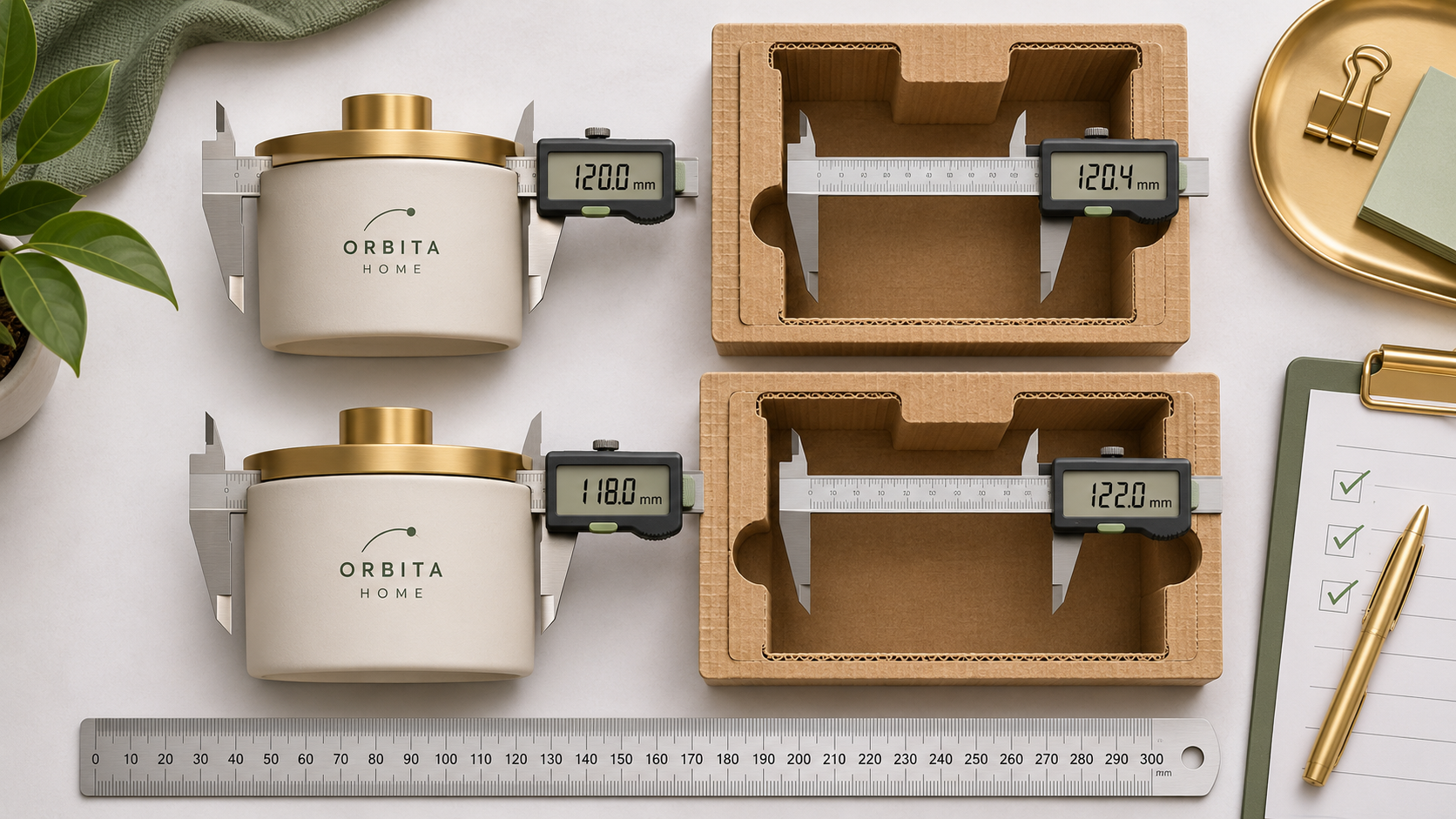
Orbita Home product and corrugated insert dimensions compared with digital calipers
A fit decision needs both extremes: maximum packed product and minimum usable cavity.

WORKED EXAMPLE

A 1 mm nominal change can decide the fit

Hypothetical example: maximum product is 202 mm, protection adds 4 mm at each end, and operations requires 3 mm total loading clearance.

Proposed usable lengthMinimum after variationClearance over 210 mm packDecision
214 mm ±2212 mm2 mmFails 3 mm trial target
215 mm ±2213 mm3 mmArithmetic passes; trial required

These figures illustrate tolerance logic, not standard corrugated tolerances or a production promise.

02

TIGHTEST FIT

Largest product × smallest box

Include bags, sleeves, caps and protective parts in the maximum product envelope. Subtract it from the minimum usable cavity on each axis. The remaining clearance must support the real loading method without forcing the walls.

Do not apply one universal clearance. A hand-loaded ceramic, an automated pouch and a foam-supported instrument need different allowances and trials.

03

LOOSEST FIT

Smallest product × largest box

The opposite combination reveals potential movement. If the product can travel, rotate or escape the insert, decide whether restraint, orientation or structure should change.

Recheck outside dimensions separately when pallet pattern, shelf space or parcel size constrains the project.

RELEASE CONTROL

Fit approval record

Keep the decision with the specification, named sample and purchase record so the next order does not restart from memory.

Product revision and min/max packed dimensions are named.

Box measurement basis, locations and permissible variation are agreed.

Insert, accessories and protective components match the intended pack.

Loading force, removal, bulging and closure are checked.

Any material, product or insert substitution triggers review.

SOURCE NOTES

Use current requirements for the actual project

These references support the decision framework. Supplier capabilities, carrier rules, retailer requirements and acceptance limits must be confirmed for the individual order.

NEXT STEP

Bring the numbers into the packaging brief

Apex Packaging Solutions coordinates custom packaging design, sampling, overseas production and delivery for Canadian and US buyers.

Discuss your project →Explore corrugated boxes