
Knowledge base · Pharma and medical
Pharmaceutical packaging - label control, clean specs, and damage reduction.
Pharma and medical packaging programs rarely fail because the box was missing one more layer of board. They fail when the specification leaves too much open to interpretation: label placement, lot control, tamper evidence, cleanliness, or how the product sits inside the shipper.
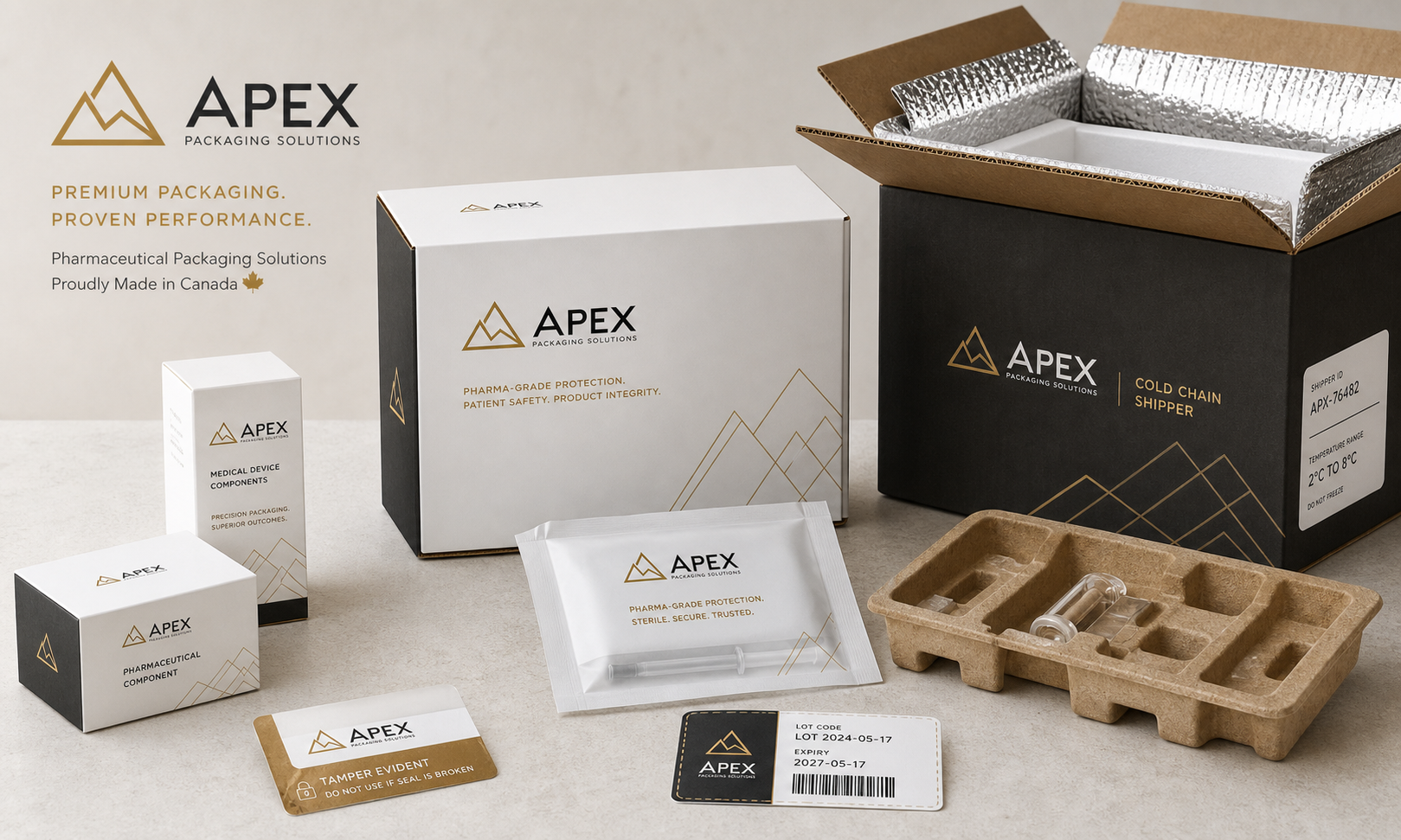
Pharmaceutical packaging buyers in Canada usually do not need the most complicated pack. They need the most controlled one. A carton, device shipper, or kit pack can look acceptable on a sample table and still fail in production because the label panel was not reserved, the sterile pouch was floating inside the outer case, or the receiving team could not confirm lot identity without opening the shipment. Those are avoidable specification problems. They create rework, damage, and audit friction long before anyone debates print finish or unit cost.
Apex Packaging Solutions supports buyers who need pharma boxes, protective inserts, and corrugated shippers aligned around real operating constraints. For pharma and medical-device programs, the correct conversation usually touches both the outer carton and the internal protection stack. That can include clean board specifications, tamper-evident closures, sterile-barrier compatible inner packaging, and the protective packaging needed to keep labels, components, and device geometry intact through transit.
Start with control points, not just dimensions
Packaging briefs for regulated or semi-regulated products often begin with size and quantity. That is necessary, but it is not enough. Pharma packaging is more sensitive to control points than a general industrial shipper. Buyers should define what has to remain visible, traceable, clean, and undamaged from packout to receiving. That means asking where the lot code sits, which panel carries the primary label, whether tamper evidence is mandatory, and whether the outer pack needs orientation control for kits, vials, devices, or accessories.
| Control point | What buyers should define | Why it matters |
|---|---|---|
| Label control | Primary label panel, barcode zone, and lot-code placement | Prevents relabeling, blocked data, and receiving errors. |
| Clean specification | Board type, inner-pack material, and handling expectations | Keeps the pack matched to device or healthcare requirements. |
| Tamper evidence | Seal type, opening logic, and verification point | Supports receiving confidence and downstream compliance steps. |
| Damage reduction | Internal fit, cushioning, and shipper orientation | Stops movement that can crease labels or damage fragile components. |
If the product also needs a dedicated shipper, treat the outer carton as part of the regulated system rather than a separate commodity purchase. The corrugated spec, the insert, and the labeling surfaces all influence whether the final pack performs consistently.
Label control is usually the first hidden failure point
Many pharmaceutical-packaging issues are not dramatic transit failures. They are small process failures that force manual intervention: barcode panels crossing a fold, labels placed where scuffing occurs, or multiple SKUs packed in a way that makes verification slow at receiving. Those issues do not always show up during the first sample because the pack looks clean while stationary. They show up when operators pack quickly, when cartons rub in a case, or when lot coding has to be read through a real warehouse flow.
- Reserve a stable print or label panel that does not cross a seam or lock area.
- Define barcode orientation early so scanners do not depend on carton rotation at receiving.
- Separate SKU identity from shipping marks when the same outer format supports multiple variants.
- Protect printed and labeled faces from internal abrasion or contact with hard device components.
This is one reason many buyers pair the primary packaging review with the shipper review. A well-designed carton can still fail if the transit pack lets units slide against each other. When the issue is internal movement, the next practical reference is the Apex guide to custom foam inserts. The label problem may actually be a protection problem.
Clean specs should be written so procurement can repeat them
In pharma and medical-device work, "clean" is often used too loosely. Buyers should convert that word into repeatable specification points. Is the request for a documented board grade, a clean white folding-carton stock, a sterile-barrier compatible pouch, a tamper-evident closure, or an insulated shipper for temperature-sensitive kits? Each of those belongs in the RFQ. Otherwise the supplier is left to infer the requirement, and the next reorder may not match the original approval standard.
| Spec area | Typical question | Procurement outcome |
|---|---|---|
| Board and carton material | What substrate and finish were approved? | Reduces variation between sample and production. |
| Inner packaging | Does the quote include sterile pouch, liner, or insert? | Prevents scope gaps between components. |
| Tamper evidence | Is the seal visual, destructive, or label-based? | Aligns the pack with receiving and end-user expectations. |
| Temperature or handling | Does the route need insulation, gel, or orientation control? | Keeps sensitive product kits from being under-protected. |
For many programs, the pack is a hybrid of carton, corrugated shipper, and interior support. Apex's corrugated packaging and protective-packaging teams are most useful when those elements are quoted together instead of split across separate RFQs that leave fit and accountability unclear.
Damage reduction in pharma shipping is often an internal-fit problem
When buyers hear "damage reduction," they often think only about crush strength. That matters, but the more common problem in pharma kits is internal disturbance. A device, vial tray, accessory pack, or instruction set shifts inside the shipper, which damages the product, the label, or both. The fix is often a better interior layout rather than a heavier outer carton. That may mean a paperboard insert, a corrugated divider, a foam cavity, or a simple orientation feature that keeps the heaviest component from contacting the printed face panel.
- Confirm the packed unit: device, kit, vial set, or accessory bundle and how it sits in the primary carton.
- Confirm the shipper route: parcel, LTL, cold-chain handoff, or mixed warehouse handling.
- Confirm the failure risk: scuffed labels, cracked housings, broken seals, or receiving confusion.
That workflow is more useful than automatically moving to thicker board. If the unit is medically adjacent, high value, or audit-sensitive, the outer pack should be strong enough, but it should not be asked to solve identity and internal-fit problems it cannot control on its own.
What to send before requesting a pharmaceutical-packaging quote
Quotes move faster when the request describes the operating reality instead of only the carton size. Buyers should send:
- Product type, unit dimensions, unit weight, and whether the job is a device carton, kit, shipper, or mixed-component pack.
- Primary label, barcode, lot-code, and orientation requirements, including which panel must remain visible.
- Tamper-evident needs, seal format, and whether the pack must show first-open evidence.
- Any inner packaging included in scope: sterile pouch, paperboard insert, corrugated divider, foam insert, liner, or insulated component.
- Transit route details, including parcel, LTL, export, or temperature-sensitive movement.
- Current failure mode: label scuffing, broken seals, internal movement, crushed corners, or receiving delays.
- First-run quantity, reorder profile, and target approval date.
The best pharmaceutical pack is easy to repeat
Pharmaceutical packaging performs best when the approved pack is clear enough to reorder without reinterpreting it every cycle. That means the quote should lock down the visible control points, the clean material stack, the tamper-evident method, and the protection level in one specification. Buyers save time when they do not have to reconstruct those details from email history after each release.
If your current pharma or medical-device shipment is creating label errors, damaged kits, or too much manual receiving work, send Apex the packed unit, the control requirements, and the transit route. That is usually enough to review whether the fix is a better carton layout, a cleaner documented spec, or a protective shipper system built around the actual failure point.
Related
Send the control points before you quote pharma packaging.
Label panel rules, lot control, transit route, and any inner-pack components are enough to review the right pack structure.