
Knowledge base · Food multipacks
Food multipack boxes: plan counts, fit and distribution.
Map the sealed primary pack, retail multipack, shipping case and pallet before specifying the box or its labels.
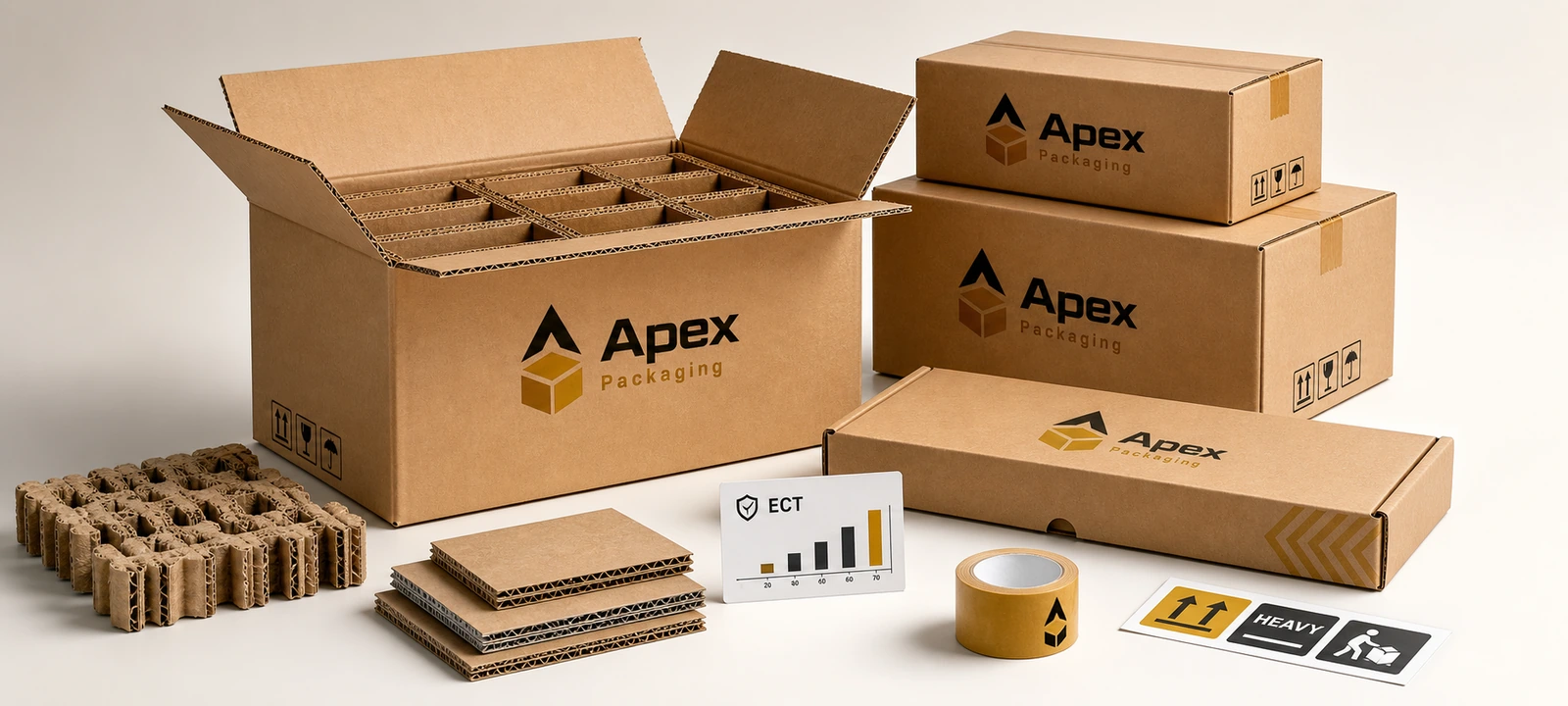
A food multipack or outer case should begin with the sealed primary package and the distribution hierarchy. Buyers need to define unit dimensions, case count, packed weight, orientation, retail presentation, pallet route, label data and whether any packaging component contacts food. Those decisions affect fit, board specification, handling and documentation.
Use this guide to prepare the project brief. For an Apex purchasing enquiry, review custom food packaging boxes and send primary-pack details, required counts, artwork, quantities and delivery destinations.
Map every packaging level
| Level | Main question | Information to record |
|---|---|---|
| Primary pack | What directly contains and protects the food? | Maximum dimensions, weight, seal areas, product variation and intended use |
| Retail multipack | How many units are sold together? | Count, orientation, opening, consumer information and barcode ownership |
| Shipping case | How does the product move through distribution? | Case count, packed weight, closure, labels and handling route |
| Pallet load | How are cases supported and stacked? | Pattern, layers, overhang limits, storage and transport conditions |
A single box can sometimes perform more than one role, but the buyer should still document each requirement. Retail graphics do not replace shipping-case performance, and an outer case does not replace the food-safety requirements of a direct-contact component.
Set the count from geometry and handling
Measure representative filled primary packs, including seals, gussets, closures and permitted fill variation. Compare arrangements using the actual orientation and allow for practical loading rather than calculating from nominal dimensions alone. Record whether staff, a case packer or the consumer opens the pack.
Case count also changes packed weight, manual handling, pallet efficiency and the number of retail units exposed when a case is opened. Evaluate those trade-offs with operations and the retailer instead of selecting the largest count automatically.
Specify the distribution case as a system
Case weight is not enough to prescribe a corrugated construction. Dimensions, flute and liner combination, box style, product support, stacking pattern, humidity, storage duration, pallet deck and handling route all influence performance. Ask suppliers to state the complete board and box specification behind a quote.
ASTM D642’s official summary describes compression testing for shipping containers and notes that the package can be tested with or without contents. That test addresses a defined question; it does not establish suitability for every distribution hazard. Use route-specific validation and acceptance criteria.
Separate food-contact documentation from general box approval
Identify which components contact food directly and which hold an already sealed primary pack. The Canadian Food Inspection Agency states that food businesses are responsible for the safety and suitability of packaging materials and that most packaging is not generally preapproved by CFIA. Obtain supplier documentation for the intended use and keep it with the product and packaging specification.
Do not extend documentation for one coating, adhesive, ink or material to another construction without evidence. Regulatory, allergen, migration and hygiene questions should be reviewed by the responsible food-safety team.
Control labels and packaging-level identifiers
Record the data owner and required identifier at each level. GS1 Canada explains that different packaging formats and levels can need distinct GTINs. Barcode size, quiet zones, placement and print surface should be checked on the assembled pack for the intended scanner and retail process.
Hypothetical example: six sealed pouches fit a retail multipack, while four multipacks fit a shipping case. Changing the pouch count changes the consumer unit, case weight, carton artwork and possibly the identifier. Treat it as a controlled packaging change rather than only a dimensional revision.
Food-box RFQ checklist
- Product category and whether each component has direct or indirect food contact.
- Filled primary-pack dimensions, weight, variation and orientation.
- Units per multipack and multipacks or units per shipping case.
- Retail-display, opening, tamper or consumer-information requirements.
- Case dimensions, packed weight, closure and pallet configuration.
- Storage, humidity, parcel, case and pallet route assumptions.
- Artwork, barcode ownership, GTINs and variable-label zones.
- Required supplier documentation, quantities and delivery destinations.
Frequently asked questions
Is a dry-food multipack the same as food-contact packaging?
Not necessarily. A box may hold sealed primary packs, or a component may contact food directly. Map every layer and obtain documentation for its intended use.
Can board strength be selected from case weight alone?
No. Case dimensions, construction, stacking, storage, humidity, pallet support, handling and product support also affect performance.
Does a new multipack need a new barcode?
It may. Different products, packaging formats or packaging levels can require unique identifiers. Confirm allocation and retailer requirements with the responsible data owner.
Primary references
Related
Quote the box around the complete pack hierarchy.
Send primary-pack details, counts, packed weights, artwork, route, documentation needs, quantities and destinations for a food-box quotation.