
Knowledge base · Ecommerce packaging
Ecommerce packaging in Canada - mailers, RSC boxes, and poly mailers.
Many ecommerce teams start by asking for a branded mailer, then discover that their SKU mix, parcel rate, or returns flow really calls for a different outer pack. The right format depends less on trend and more on product rigidity, order pattern, dimensional weight, and how often the pack will be reordered.
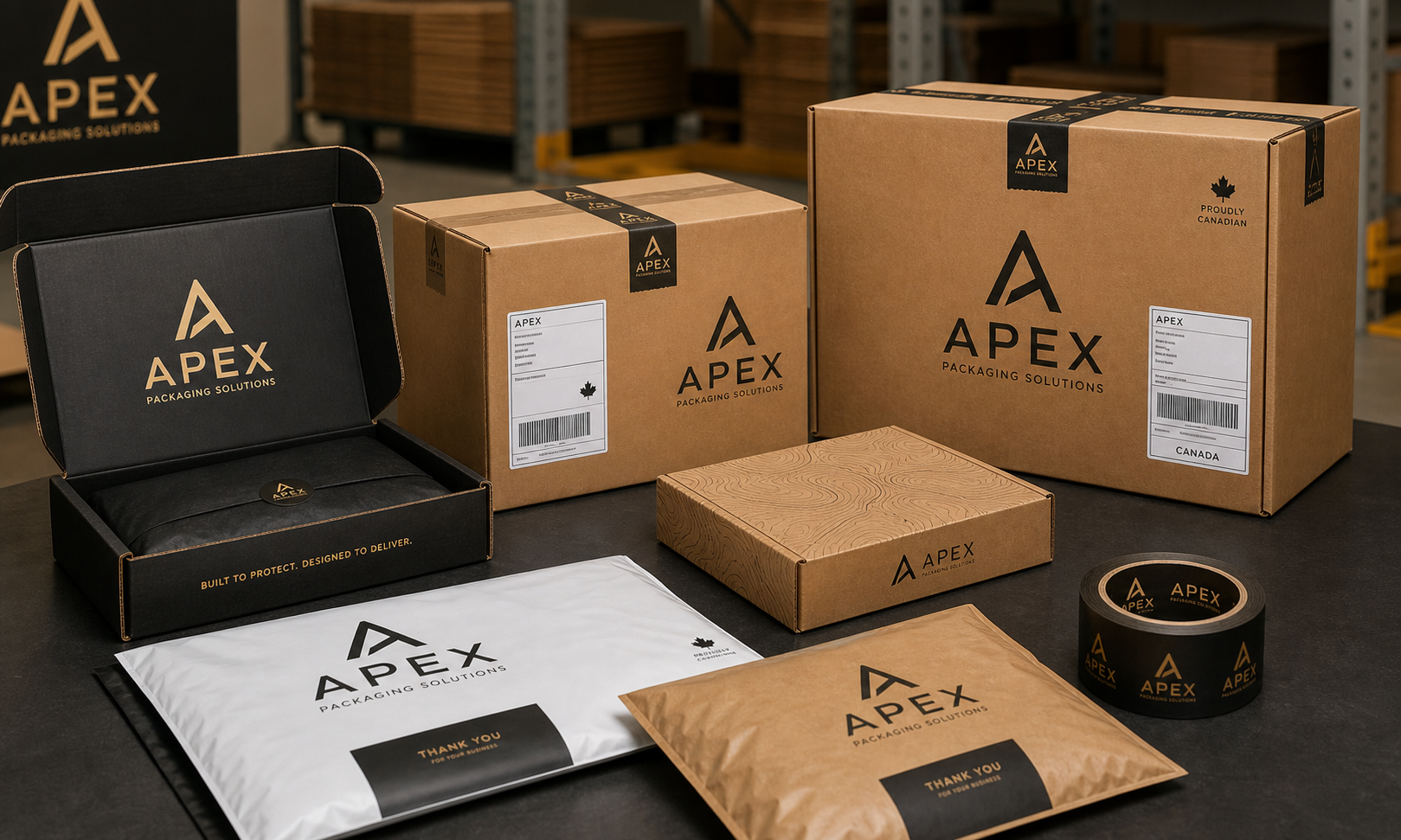
Ecommerce packaging in Canada is usually not one packaging decision. It is a system decision that has to balance parcel handling, presentation, order variability, and reorder speed. A premium unboxing experience matters for some brands, but so do dimensional-weight charges, warehouse packing speed, and whether the format still works when promotions change the order contents. That is why the best format is not automatically a custom mailer. In many programs, a standard RSC shipper or a poly mailer produces a better result.
Apex Packaging Solutions supports ecommerce buyers who need custom mailer boxes, corrugated shipping boxes, and polybags and poly mailers aligned to the actual fulfillment pattern. The practical question is not which format looks best in isolation. It is which one protects the order, controls freight, and reorders cleanly at the volumes the business can actually support.
Choose the outer format by product behavior, not by packaging trend
The fastest way to overpay for ecommerce packaging is to decide on structure before defining what the product does in transit. Ask three questions first. Does the product need rigid protection? Does it ship as one repeatable SKU or as changing order combinations? Does the brand need the package itself to carry the opening experience? Those answers usually narrow the format quickly.
| Format | Best fit | Watch-out | Buyer question |
|---|---|---|---|
| Custom mailer box | Branded D2C orders, giftable items, subscription kits, medium-fragility products | Can add setup, print, and insert cost faster than expected | Does the product need presentation and a controlled fit? |
| RSC corrugated shipper | Heavier products, mixed-SKU orders, outer-shipper use, lower-cost repeat lanes | Often needs void fill or partitions to prevent internal movement | Is the job mainly freight protection rather than display value? |
| Poly mailer | Soft goods, apparel, non-breakable refill packs, lightweight low-cube shipments | Poor choice for crush-sensitive or premium-rigid goods | Can the product flex without damage or brand loss? |
This is why two products with the same sale price can need completely different packs. A skin-care set with glass bottles may need a printed mailer and insert. A bundle of folded garments may ship better in a branded poly mailer. A heavy reorder carton with multiple SKUs may be better in an RSC with paper void fill and no premium outer print at all.
Use custom mailer boxes when fit, presentation, and repeatability matter
Custom mailers are the best-known ecommerce format because they combine protection with presentation. They work well when the opening experience matters, when the product shape is stable, and when the brand wants the box to do part of the marketing job. They are also useful when an insert, divider, or inside print helps guide the customer through the contents. The Apex guide to custom mailer boxes for ecommerce goes deeper on print and MOQ, but the core buying rule is simple: use a mailer when the product benefits from a defined cavity and the box itself is part of the value proposition.
What mailers do not solve well is high order variability. If one day the order contains one SKU and the next day it contains four mixed items, a fixed custom mailer can become inefficient fast. Buyers either carry too many sizes or ship empty space. That is where a more flexible corrugated shipper often wins.
Use RSC shipping boxes when protection and fulfillment flexibility come first
RSC boxes are less glamorous than a custom die-cut mailer, but they are often the more efficient ecommerce choice. They are especially useful for heavier items, replenishment orders, mixed baskets, and programs where the outer carton is mainly there to survive parcel handling. They are easier to source across more sizes, easier to swap when order patterns change, and often cheaper to keep in inventory. If the main job is protection rather than unboxing theater, a regular corrugated shipper is frequently the better buy.
This does not mean every RSC performs well by default. Right-sizing still matters, and so do board grade, void fill, and pack orientation. If the team is deciding between a standard shipper and a more custom conversion, the Apex comparison of RSC boxes versus die-cut boxes is the right companion piece. That article helps when the structural trade-off is the main question, while this guide focuses on ecommerce lane fit.
Use poly mailers only when the product can tolerate a flexible outer pack
Poly mailers are attractive because they cut cube, reduce weight, and keep parcel costs down on suitable products. For apparel, soft accessories, and some refill formats, they are often the most efficient pack. They also make sense when the item does not need rigid edge protection and the brand wants a lightweight branded outer layer for high-volume shipping.
Where buyers get into trouble is using poly mailers for products that only look durable on a tabletop. If a product can dent, scuff, crease, chip, or burst through the seam under parcel pressure, a mailer bag becomes false economy. Poly mailers should be chosen with the same discipline as corrugated: film type, gauge, seal strength, and finished bag size all matter. When the question is material thickness rather than format, the Apex poly bag thickness guide is the next reference to use.
Many ecommerce programs need two packaging formats, not one
Buyers often assume they should standardize on a single format across the entire catalog. In practice, many strong ecommerce programs split packaging into two lanes. One lane uses a branded mailer for hero SKUs, giftable products, or subscription orders where presentation matters. The second lane uses RSC shippers or poly mailers for replenishment, soft goods, or mixed-basket fulfillment where freight efficiency matters more than the opening sequence. That approach usually reduces compromise because each format has a clear job.
It also makes reordering easier. Teams can hold a few proven packaging formats tied to actual order behavior instead of forcing every item into one expensive structure. The real objective is not packaging consistency at all costs. It is a packaging system that matches how the warehouse ships today and how the brand expects volume to change over the next few purchase orders.
What to send before requesting an ecommerce packaging quote
Quoting moves faster when the RFQ describes the order pattern, not only the product dimensions. Buyers should send:
- Packed product dimensions and total packed weight, not only item size before inserts or protective material.
- Whether orders usually ship as a single SKU, a small kit, or a changing basket of mixed items.
- Fragility notes such as glass, liquid, crush-sensitive corners, printed sleeves, or products that scuff easily.
- Whether the brand wants the outer package to carry presentation value or only transit protection.
- Preferred format if known: custom mailer, RSC shipper, poly mailer, or a comparison quote across two options.
- Target MOQ, reorder frequency, and whether the first run needs a sample or physical mockup.
- Any need for inserts, paper void fill, branded tape, labels, or inside print.
The better the lane detail, the easier it is to decide whether the right answer is a mailer, an RSC, a poly mailer, or a two-format packaging program. If your team is trying to reduce parcel damage, lower dimensional-weight cost, or make the packaging look more intentional without overbuilding it, send Apex the packed SKU list and typical order pattern first. That is usually enough to review the right structure before design time or inventory gets wasted.
Related
Send the SKU mix before you choose an ecommerce pack format.
Packed dimensions, weight, order pattern, and branding requirements are enough to compare mailers, RSC boxes, and poly mailers.